I've had this day marked on my calendar ever since the announcement was first made.
Today is the day bitcoin micro-futures come to market.
A Perfect Union: Bitcoin & Futures
When bitcoin futures came out a few years ago, I was overjoyed. It was the union of two of my favorite things: bitcoin and futures.
What did this mean for the bitcoin market?
Bitcoin futures help large traders to hedge exposure. In other words, the product allows institutional traders to legitimately purchase large amounts of bitcoin.
An Even More Perfect Union: Bitcoin & Micro-Futures
With the recent increase in bitcoin's price, retail investors (like me) have a hard time trading bitcoin futures. At a price of $50,000 the position size is difficult to maintain.
Translation: You need a ~$100,000 account to trade bitcoin futures.
Today is a new day!
Starting May 3, the CME is trading micro-sized bitcoin contracts (MBT). These contracts are available at 1/10 the size of one bitcoin.
Translation: You'll only need a ~$10,000 account to trade micro-bitcoin.
You can think of this like a stock split for futures contracts. This will increase the number of retail traders that can trade in the market.
Stay
tuned for technical MBT charts at the end of the month. We'll also be
including MBT in automated trading strategies. You can sign up for
updates about that here.
NinjaTrader 7 MBT Add-on Instructions
If you follow me, you know I use the old NinjaTrader 7 platform. See below for instructions on how to add MBT contracts to the NinjaTrader 7 platform manually:
From the Control Center, navigate to Tools -> Instrument Manager. Select “New” Fill out the information as below: Master Instrument : MBT Instrument type: Future Tick size: 5 Currency: US Dollar Point Value: 0.1 Session template: CME Micro Bitcoin Futures Description: CME Micro Bitcoin Futures Exchange: Globex
Next, select the ‘Misc’ tab; scroll down to the ‘Interactive Brokers’ Symbol Map and enter the below: BRR|CMECRYPTO|||0.1
Click "OK" to save your changes.
Please note that BTC and MTB cannot be enabled at the same time due to them having the same mapping.
Please disable the BTC instrument.
From the Control Center, navigate to Tools -> Instrument Manager. Search for BTC. Once found, click BTCand select "edit". Click on the 'BTC' tab Scroll down to the Symbol Mapping for Interactive Brokers and add the word "-disabled" just after the instrument name.
One of my favorite movies is Scarface. And, this is one of my favorite quotes:
“In this country, you gotta make the money first. Then when you get the money, you get the power. Then when you get the power, then you get the women.”
-Antonio "Tony" Montana; fictional character and the main protagonist of the 1983 film Scarface
The goal of money is a little different. Money's ultimate goal is to be a 'unit of account'. That is, it doesn't become a true gangsta until it hits 'unit of account' status. And, in this world, first you get the store of value, then you get the medium of exchange, then you get the unit of account.
Bitcoin is at the unit of account stage all over the world. It has arrived and there's nothing anyone can do about it. Why? Just listen to what Brad Sherman is saying in the video below. He is our unwitting advocate.
(57 seconds in: Brad Sherman, US Congress, Arguing against Bitcoin)
In
May of 2018, Brad made a plea to abolish Bitcoin because he views it as
a direct threat to the U.S. dollar. Specifically, he wants to make the
purchase of Bitcoin illegal. What implications does this have for the
U.S. if the rest of the world doesn't follow suit? In a nutshell, it
means there's about to be a massive redistribution of wealth from the
U.S. to the rest of the world, specifically, to the those countries with
the most Bitcoin.
What's key in this testimonial is that Sherman is merely stating what other nations are saying as well. And, if our enemies have an interest in hurting the U.S., one way to do so is through the strategic purchase of Bitcoin as a reserve currency, and that's exactly what's happening. Central banks across the globe are buying Bitcoin.
How Are Other Nations Responding To Bitcoin?
Sovereign states are making statements with regard to "their" reaction to the Bitcoin "threat". Some nations like Canada and Russia have embraced it. Countries all over Africa have embraced it. The entire middle east has embraced it. South America has embraced it. A few politically challenged industries have embraced it (read: marijuana, gambling and porn). The entire West Cost of the United States has embraced it. This is why the price refuses to go down. It has too many advocates and that advocacy grows with every bomb, sanction and tariff.
Meanwhile, what are Americans being told? Bitcoin is simply a modern day case of tulip mania -- it's a nothing burger, a scam, a Ponzi scheme, a tool for criminals, punks and terrorists. And yet, one Bitcoin is still worth more than an ounce of gold.
The truth is, Bitcoin has already become the world's reserve currency, but we (Americans) are the last to know. And, if folks like Brad Sherman have their way, Americans will be left out of owning Bitcoin altogether.
What Does That Mean For The Coming Redistribution of Wealth?
What does this mean for the future? From a global perspective, it means the meek will inherit the earth. From a national perspective, it will play out in a civil war between the banking and technology sectors; the old and the new guard. America will continue to evolve and thrive, but there will be a reckoning of sorts, a changing of the 'money' guard as the value of all assets backed by the U.S. dollar, directly or indirectly, gets absorbed by Bitcoin.
Bitcoin Represents a Threat to The Permanent State, Not America
Bitcoin represents a threat to sovereignty and the current power structure, not America or its values. In fact, if America's forefathers had Bitcoin, they would have used it. They were advocates of a small and limited government, by the people and for the people. The war between America and the Permanent State's government is coming, but America's adoption of Bitcoin will make sure America doesn't get taken down with the Permanent State's dollar scheme. America is an ideal, not a currency. We let the dollar use our name for a while, and now we want it back.
“I should have called the Estonians when we were setting up our health care website.”
-Barack Obama
Estonia has become the American dream. The country offers its citizens something it seems Americans can only dream about (we are always dreaming). Blockchain, the technology behind bitcoin, has made the American dream of liberty, freedom and democracy a reality...in Estonia.
When the world thinks democracy, they think 'America'. They may not
think 'United States', but they do think America. That's because
America is an ideal, not a place. Like bitcoin, the goal of America is
freedom through democratized power; that is, power of the people. I
write about this connection in the post: Bitcoin & America Have Common Goals: They Are Linked By The Ideal of Democracy. When
I wrote the post I had no idea that a country like Estonia existed.
Its discovery has had my attention ever since. And, one thing has been
made clear in my research -- Estonia is more American than America. How
did this happen?
Estonia's digitization
Estonia’s digitization began in 1991. Just after the break-up of the Soviet Union, Estonia restored its independent statehood from the USSR.
It was a poor country with little in the way of infrastructure, so it
decided to use technology as a way to leverage its scarce resources.
Now, Estonia is using blockchain technology to create the world's most democratized country. I'm going to use the rest of this post to explain how.
First, let me introduce blockchain.
Blockchain
is the underlying technology used to create bitcoin, but as Estonia is
showing the world, it can be used for many other things.
At
its heart, blockchain technology is 'trust' technology. It comes with a
decision framework that replaces trust with consensus. The decision
framework within blockchain builds a consensus based on a network of
all users rather than a centralized control system. As a result, there
is no need for trust. Governance decisions are made by consensus and
all data exchanged is protected through encryption (crypto). Put
another way, the system is naturally democratized rather than
centralized. In this way, it is also self-sustaining. So, when you hear
about a system being converted to blockchain, it means the system is
being taken from a centralized to a democratized decision framework.
Easy implementation: Digital ID
So how does all this work? Well, every Estonian is issued a digital ID.
Much more than a legal photo ID, the digital ID has been
"blockchained". That is, it's been democratized on a blockchain
platform that uses a 2048-bit public key encryption.
Estonia has been issuing digital IDs for the past two decades. The ID serves as:
a fully encrypted digital passport for Estonian citizens traveling within the EU
a national health insurance card
identification when logging into bank accounts
a proxy for digital signatures
a proxy for i-Voting (public voting occurs online)
a way to check medical records, submit tax claims, etc. (filing a tax return takes less than five minutes)
a way to use e-Prescriptions
The
card doesn't just make life easier for Estonia's citizens, it also
saves a great deal of time for the government which translates into real
savings and a boost to GDP.
According to a report by PWC, Estonia saves over 1400 years of working time and 2% of GDP annually
through its digitized public services. Today, 99% of public services
are available to citizens as e-services. Since all transactions are made
on a general ledger secured by blockchain-based time-stamping, you
also know if someone other than you has accessed your records.
This
leads me to perhaps the most important aspect of Estonia's
digitization process -- you own your data. The data may be in Estonia's
database, but it belongs to you. You have the right to know and
control what happens to the data. In other words, sitting behind the
automated governing body is a legal framework that ensures responsible
use. Your digital ID (online signature, security, and rights) is
protected by law and data integrity is ensured by blockchain technology.
Kersti Kaljulaid
For those that think issuing a digital ID requires a massive financial
commitment, you are wrong. A central tenant of the Estonian
digitization strategy is the use of cheap technology. Which is to say,
this isn't an effort that requires massive fundraising.
According to Kersti Kaljulaid, "Cheap, common technology that is
inclusively used by society as a whole brings much greater benefits
than exclusive ones only accessible to upwardly mobile populations."
She would know. She is also the fifth and *current President of Estonia (in office since October 2016).
Estonia is not alone
Estonia
isn't the only country to see the digital light. Germany has given its
citizens an ID card with a digital chip, and Finland has joined
Estonia on the same data-exchange platform. There are also amazing
things happening in Africa, with widespread usage of mobile payments
and different practical applications for farmers in Rwanda and Senegal.
To read more about the trend in Africa and the Middle East see: Can Digital Currency (Bitcoin / M-Pesa) Wipe Out World-Wide Corruption & Poverty?
Meanwhile, the U.S. is trying to ban bitcoin. The current administration believes bitcoin is a national threat, but I believe banning bitcoin is the national threat and you can read more about my prediction for the U.S. if it bans bitcoin here.
It's time for a new paradigm
Named ‘the most advanced digital society in the world’ by Wired,
Estonians have Trumped us. We are so far behind the Estonians it's
"tremendously" ridiculous (I'm channeling Trump now). If we were
to find our way to the highest digital mountain in America, we still
wouldn't be able to see the digital dust left by the Estonians. It's
that bad.
It's so bad, that Estonians have actually come to expect better services from government than they do from the private sector.
I
don't know where you're from, but think about that. It's hard to
comprehend if you're American. This is the American ideal, yes, but
we've been told there's no money for anything but war. We're still
trying to figure out what happened to trillions of dollars in lost funds
(Mark Skidmore, a professor of economics at Michigan State University, found that $21 trillion in unsupported adjustments had been reported -- that’s about $65,000 for every American).
It's
time for Americans to stop dreaming. We need to take our name back
from the dollar, adopt bitcoin, and overhaul the government with
blockchain technology.
If you've read any of my previous posts you know that I'm a big fan of three things:
Trading Futures
Liberty and Economic Justice (Blockchain / Bitcoin)
Automated Streams of Income
This post touches on all three categories; it ties trading NASDAQ futures to automated trading strategies, which can lead to economic freedom.
So what's the catch?
The catch is that you have to find profitable trading strategies.
What is an automated trading strategy?
Automated trading (also referred to as algorithmic trading) is a trading strategy that makes automated trades based on a set of inputs or a program that you create. Traders like to use automated strategies to remove emotion from the decision making process when making trades.
For example, here's a description of the automated trading strategy we refer to as Strategy #5.
This strategy made over $15K in 1,000 trades between 10/18/2020 and 1/6/2021. It made 13.16 average trades per day and had an average daily profit of $194, which is a profit of $15 per trade:
Strategy #5 uses the MACD Indicator (MACD), Double Stochastics (DS) and the Relative Spread Strength (RSS). These are all commonly provided by trading platforms for traders to include on charts.
So what do you do with these indicators?
You use them to develop a strategy and then you automate that strategy.
Here’s how you would describe and automate Strategy 5:
Enter Long - When MACD (MACD plot) crosses above MACD (Avg plot), with a look back period of 2, AND, when DS with an RSS input series, is greater than 90.
Exit Long - When MACD (MACD plot) crosses below MACD (Avg plot).
Enter Short - When MACD (MACD plot) crosses below MACD (Avg plot), with a look back period of 2, AND, when DS with an RSS input series, is less than 10.
Exit Short - When MACD (MACD plot) crosses above MACD (Avg plot).
For MACD, use 26 as the Slow parameter, 9 for Smooth, and 12 for fast.
For RSS, use 10 for EMA1, 40 for EMA2, and 5 for Length.
You can test this strategy by duplicating our results (see the chart below).
This is what the strategy looks like in chart form:
Which automated trading strategies are the best and how do you you know?
This is what we do -- we hunt for high performing automated trading strategies for the NQ futures contract.
We've tested over 500 strategies and we're sharing our best performing strategies with you.
The following are the best performing strategies:
Backtest Results based on ~1,000 trades
Backtest Results based on 1 year of trades
Our results are based on how well the strategy performs after 1,000 trades and how well it does after one year of trading. Then, we compare each strategy based on the following attributes:
Drawdown
- This refers to the maximum drawdown statistic, which provides you
with information regarding the biggest decrease (drawdown) in account
size experienced by the strategy. Drawdown is often used as an
indicator of risk.
Drawdown = single largest Drawdown
As
an example, your account rises from $25,000 to $50,000. It then
subsequently drops to $40,000 but rises again to $60,000. The drawdown
in this case would be $10,000 or -20%. Take note that drawdown does not
necessarily have to correspond with a loss in your original account
principal.
Profit - The net profit made on the strategy for the backtest.
#trades per day - The average number of trades made per day using the strategy.
Profit / Day - The average profit made per day.
Profit / Trade - The average profit made per trade.
Lowest daily new profit - The worst performing day of the strategy in the backtest.
Highest daily net profit - The best performing day of the strategy in the backtest.
So, how much can you make using automated trading strategies?
If you were to trade 1 NQ contract on each of our 9 strategies listed above, you could have made over $1.2 million in 2020**.
Backtest Results based on 1 year of trades
* Profit assumes no commission
You can have access to a description of all strategies with a subscription to our newsletter: Automated Trading Strategies on Substack. A subscription gives you the opportunity to use and copy our best strategies.
Our highest performing strategy made over $270K last year.
As a subscriber, you'll also be the first to receive strategy performance updates as well as new strategies added to the list.
You will also receive:
The ability to download the strategy into NinjaTrader 7 (not available for NinjaTrader 8)
A detailed description of how to duplicate the automated strategy.
If you're already a subscriber, all strategies are available below:
Strategies are made available by description (like the description for Strategy #5 above) and/or as a download for Ninjatrader 7. If you're having difficulty creating an automated strategy with the description, please contact us directly at celanbryant @ gmail.com.
Ninjatrader 7 download instructions:
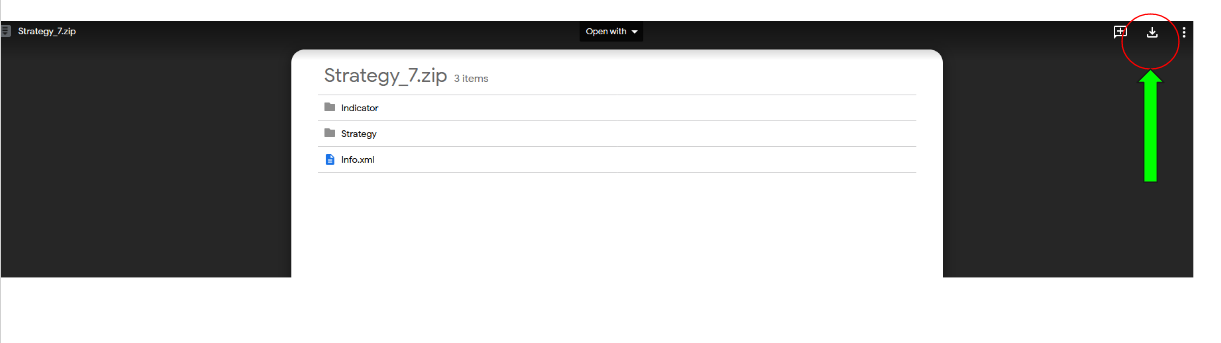
Click on the link within the post to download file from GoogleDrive.
Download the Strategy to your desktop, keep them in the compressed .zip file.
From the Control Center window in Ninjatrader 7, select the menu: File> Utilities> Import Strategy.
Select the downloaded .zip file.
NinjaTrader will then confirm if the import has been successful.
If you've never used an automated strategy in NinjaTrader 7, NinjaTrader provides instructions here.
**There is no guarantee that these strategies will
have the same performance in the future. We use backtests to compare historical strategy
performance, but there are no guarantees that this performance will
continue in the future.
Unless you're in a cave you know that the U.S. was threatened on Jan. 6 by a group of protestors that stormed Capital Hill as lawmakers debated electoral college results. The fear is that this event could make the markets unstable. Given the tools of the Federal Reserve to buy up everything in sight it's no surprise that the market rallied on January 7, especially since lawmakers have gone home until January 20. In other words, it's all on the Federal Reserve to create stability. And that's exactly what they did. On a day when the market should have tanked, it skyrocketed.
As a technical trader, I can tell you that the funds flow was strong and this buying will most likely continue until the inauguration.
What can you do now?
Buy the dip. My previous post predicted a sell-off in the first quarter, but January 6 was a game-changer. The Federal Reserve is on high alert and it will do anything it has to to protect the market. I don't know how long this market freebie will occur, but I do know that it will be very strong over the next 10 days.
So, whatever you trade, if it's related to the equity markets, now is the time to buy.
If you trade futures, like I do, that means buy all dips on whatever you trade - NQ, ES, YM. If you trade specific stocks, buy dips on those stock on a market index (Dow, NASDAQ, S&P). These are the only stocks the Fed really has to worry about from a market stability perspective, so extra care will be taken to support these equities.
I'll provide another quick update after January 20.
Technically, the market is about to take a dive in Q1. It's going to be brutal unless the Fed comes in and starts buying, which it very well might do. I'll talk about why I don't think that's going to matter in a moment. First, let's revisit bitcoin.
As advised, we hit a bottom in bitcoin in Sept/early Oct and then started trending up. We passed 13,500 by the end of October. Then we made new highs and now we're trading at 23,440.90.
I told you to get in at 11,000 in October and now we're at 23,440.90. We doubled our stack!
I'm a HODLer, so I don't sell bitcoin, but if you're in this for the trading opportunity, now is the time to take profit.
Don't fret, another opportunity is coming.
What about equity futures?
I'm putting myself on the line here, because I know the Fed can come in and start buying up assets at any time (to the point of insolvency), but I think the pressure is going to be so strong, it won't matter.
The Pressure
The pressure started last March. It's been gaining momentum all year. At some point, the bow will break and nothing will be able to stop it. That's just how the technical market goes.
The Federal Reserve has warned of this. They've been staunch advocates of direct stimulus, but politics has made direct stimulus difficult. So now we're in a pressure cooker and all it takes is one spark. That spark is 12,000. That's the RUBICON.
How will it happen?
The chart below is a daily Nasdaq futures chart. It's showing us that we need to start to selling when the Nasdaq breaks through 12,000. There might be a slight pullback on that, but it will continue down and it will continue for at least 30 days.
There will also be a pullback at around 10,000. If the market continues through 10,000 -- hold on to your horses because we're in for a wild ride.
What Else Can You Do?
I'd also start looking at buying gold (offshore) and if you own equities, focus on companies that are in countries that had a large direct stimulus package.
It shows that Japan has been the leader of the pack on
spending as a percentage of GDP. Japan started direct payments before COVID to stave off deflation. That's where the Fed got the $1,200 figure from to begin with (10,000 HK = $1,200 US). Japan
made the first direct payment in what is referred to as a helicopter
drop by the Fed. In fact, Japan did it just before the market tanked in the US
(February 2020). And, they've continued to be the front-runner in this
effort.
So, my money is on Japan. Specifically, I'm looking at companies/start-ups that rely primarily on Japanese spending.
I'll provide more commentary at the end of January. Until then, short US stocks, buy gold and companies that rely on Japanese spending, and HODL bitcoin.
As advised, we hit a bottom in Sept/early Oct and then started trending up. We passed 13,500 by the end of October.
Now that we've passed 13,500, technical charts are showing a target of 18,000 and possibly new highs by the end of the year depending on momentum. Level of support is 15,000 to 15,300.
To figure this out, we need to create a model. The model is based on the following assumptions:
1 dollar = 10,000 Cointiply coins
1 Cointiply coin = $0.0001 dollars
1 bitcoin = 56,300 US dollars
1 bitcoin =563,000,000 Cointiply coins
Now let’s make some basic assumptions about your level of activity on Cointiply.
There’s the main faucet, which can be boosted by increasing your Cointiplier (we’ll talk about how to do that in a moment).
There’s also offer walls (visiting webpages, downloading apps, watching videos), surveys, videos, and paid to click ads.
You
can also boost your earnings temporarily and permanently by playing the
game Cointivity, which is a little mining game created by the folks at
Cointiply (we’ll talk about this a bit later as well).
Last but not least, you can earn 5% interest on your balance if you have over 35,000 coins, which isn’t hard to do.
Let’s take a minute to model out how much you can make on each, starting with The Faucet.
The FAUCET
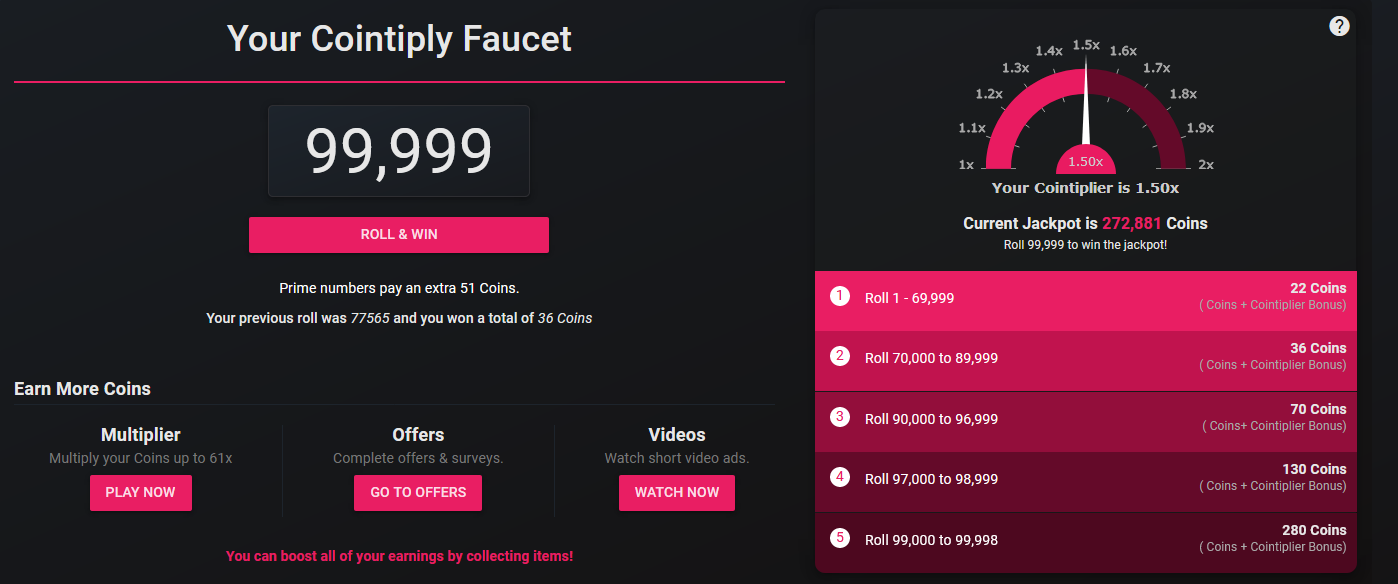
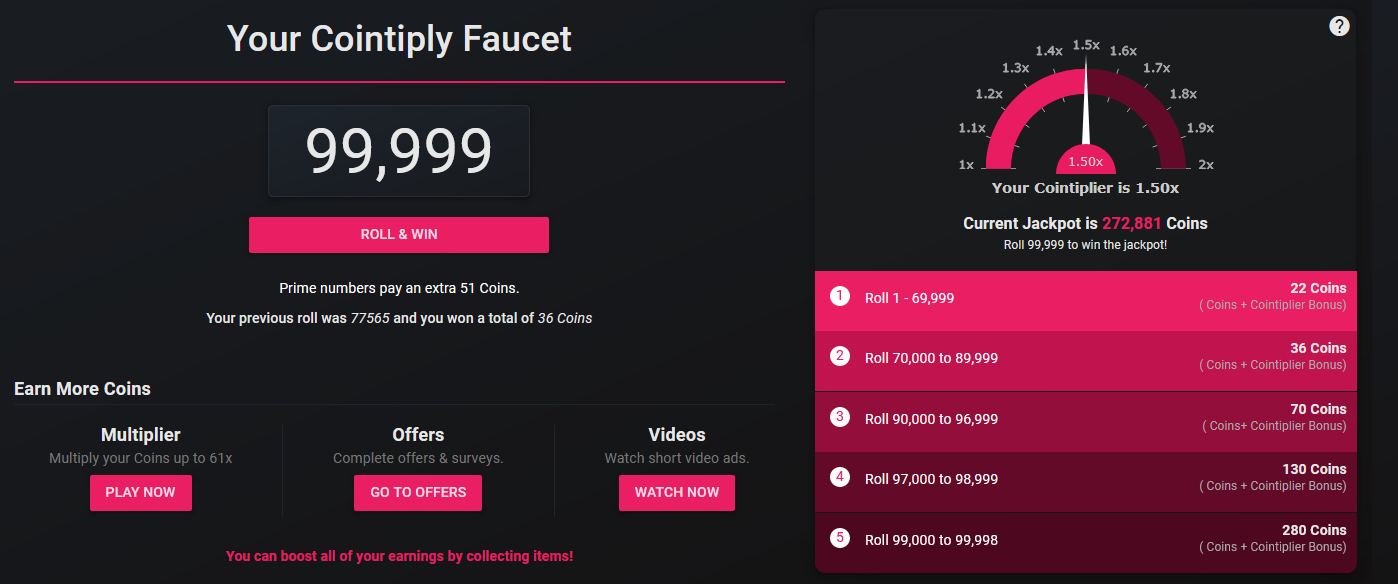
Cointiply has one of the best faucets out there. It’s attached to a progressive jackpot, which as of now is for 272,881 coins.
On average, I make around 30 coins per claim, but you can make anywhere from 22 to 280 coins. The amount depends on the roll.
For
the purpose of creating a model, let’s assume you make 22 coins per
roll and roll the faucet as often as the faucet allows (24 times a day
or once every hour). If you do this, you will make 385,440 coins, $38.54
or 0.0006846181172 bitcoin in one year.
Seems small I know, but just wait.
Important:
This is our baseline. I doubt you’ll be able to make a claim every hour
on the hour, but you may also make more than 22 coins per claim, so it
all evens out, especially because only a small portion of your payout is
going to come from the faucet (unless you win the jackpot of course).
The largest portion of your bitcoin will come from offers and maximizing
those offers, which you’ll see in a minute.
Note:
This baseline amount includes the loyalty bonus, which doubles your
reward. You get a loyalty bonus of 1% for every day you make a claim on
the faucet up to 100%. So as long as you make at least one claim per
day, you will receive the loyalty bonus.
Offer Walls
Cointiply offer-walls are a great way to earn coins. According to the website, top users earn 100’s of thousands coins
from offer walls. The most popular offer walls are Theorem Reach, Tap
Research, Adscend Media and Adgate Media. There are more than a dozen
others. They are all different, so find one you like and work it. The good news is you have variety.
A
single survey or offer can pay as much as 300,000 coins, with many
paying between 1,000 and 20,000 Coins. There are many offers for both US
and non-US players.
Tip: always click on “Earn Coins” first. You will see a list of the most popular offers as well as any new ways to earn additional coins.
Some
offers are for games and others are surveys or simply ads to click on.
Games and offers pay the most, while pay-per-click ads pay the least (9
coins per click). Cointiply paid-to-click ads are pretty normal. You
earn coins for visiting a webpage and they’re available all around the
world.
Watching
videos is one of the most passive ways to earn coins because all you
have to do is pull up a video and have it streaming. My favorites are
VideoFox, EngagMe and
Hideout.tv. You need to see 3 ads before your account will be credited.
The same applies to Hideout.TV. You earn points for every three ads
that play between videos.
For our earnings model, let’s say you can commit to doing four offers per month that average out to 50,000 coins per offer.
That’s a total of 2,400,000 coins per year or $240.
Now let’s add videos.
Let’s
say you can commit to watching two hours of video every day. You don’t
really have to watch, just have it on. You are allowed to watch video
from three different portals (cell phone, desktop, tablet) at one time.
For the purposes of this exercise, we are going to be conservative and
just use one portal for 2 hours per day. That’s a total of 43,797 coins
per year or $4.38.
Next: What if we add interest to our model?
Earning Interest
Cointiply pays 5% annual interest on coin balances over 35,000 coins.
To earn interest, you have to maintain this balance and make at least 1 claim each week.
To start earning interest, you need to go to the settings page and toggle the “Enable Interest” switch and then save your settings. Interest is paid every Sunday night.
As
a word of caution, be sure to place a 2FA on your account if you have
enough to earn interest. You can find the 2FA set up in settings.
Interest
is calculated using an annual interest rate of 5% paid out once a week
based on your average daily balance. For example, if you have 100,000
Coins for a 1 week period you will earn 99 Coins interest for that week
(100,000 * 0.05126 / 52.14). Based on our numbers above (approximately
7,400 coins per week) that equates to 370 coins per year. Not much, but
you don’t have to do anything for it.
Next: Now let’s look at how much we can make on offers, games, video and paid per click ads.
So where does that put us?
If we add offers, videos and interest to our annual tally we get:
2,831,958 coins
$283.20; and,
0.005030120818
Two things to keep in mind:
when
we first started this project, bitcoin was worth around $10,000 so
these numbers are not static. For example, bitcoin extraordinaire, the
person that introduced me to bitcoin, Max Kaiser predicts bitcoin will be trading at $240K by the end of the year. So he’s predicting an almost 500% growth rate this year.
This amount is based on both conservative and aggressive assumptions.
So now that you know about all the ways to earn bitcoin on Cointiply, let’s talk about how you can boost earnings.
The Cointivity Game & It’s Impact On Earnings
This is perhaps the main reason I like Cointiply so much — there are so many ways to boost your earnings. The Cointivity Game gives you the ability to boost your earnings.
How much can it boost earnings?
The following is an overview of how much we’ve earned so far using the model:
As you can see, the largest percentage of your earnings come from doing offers. So you can really maximize your earnings by doing two things:
Increase the number of offers you do from once per week to every day.
Boost your earnings potential on the day that you do those offers by purchasing “items”.
If
we increase the number of offers per week from once per week to seven
per week, we can increase annual earnings from $283 to $1,724.
Cointivity Maximization Strategy:
Select one day a week to do all 7 offers and then purchase items that boost earnings for that day.
To understand this, first a little tutorial on how to purchase items.
CointiPoints
are Cointiply’s reward point system. For every 10 coins you earn ,
you’ll receive 1 CointiPoint. The more Cointipoints you have, the higher
your level. You can also use these points to buy “items”. The “items”
are used for your “bitcoin mining business”.
The
goal is to collect as many items as possible to be successful with your
bitcoin mining business. However, you can only collect items if you
have a “slot” to place the item in.
Each level you go up unlocks more “slots”, which allows you to have more items.
Now, let’s figure out what kind of “items” you can place in your slots.
Items: Equippables Vs. Consumables
Everyone
starts off with 2 slots: 1 for Consumables and 1 for Equippables. Every
time you unlock another level, you also get more slots to put your
items in. Remember, you want lots of items because they boost your
earnings, but you have to have slots to place them in.
There are two types of “items” that you can buy to help your mining business: Equippables and Consumables.
Consumables are items that are consumed or used in a short period of time. They are short-term in nature and the earnings boost from consumables is temporary.
Equippables are items that are part of your equipment. They are long-term in nature and they boost your earnings permanently.
Each
item is also classified as Common, Uncommon, and Rare quality. Rare and
Uncommon items boost your earnings higher than Common items.
Where can you find items?
In Pods. You can buy Pods with either CointiPoints or coins. Every Pod contains three items. The higher quality the Pod, the higher your chance of getting Uncommon and Rare items, which are worth the most.
In these Pods you will find “items” like the ones below.
We’re not done. There are also Cointivity Collections.
Cointivity Collections
Cointivity
Collections are a way to get an even higher earnings boost. This is a
great way to maximize earnings if you know you’re going to be on
Cointiply for 4 to 72 hours.
Each
collection requires a different group of items. The most valuable
Collection also has the most Rare and Uncommon Items. Here’s a graphic
from the website of the Collections currently available:
When
you have all items in a Collection, a “LOCK IN” button appears on that
Collection. Click the button, and you will be asked to confirm that you
wish to activate the Collection.
TIP:
If you know you’re going to have a big offer day, you might want to
Lock In your Collection on the day before and then activate it on the
day you are going to do the offers.
All
of your items are part of your “Inventory”. So, at any point in time
you can check to see how many items you have by clicking on Inventory.
You can check out your level, your boosts, your slots, and the items you
have in those slots by clicking on your Cointivity Profile. Also
remember, that you can use the items to boost earnings or you can sell them for coins.
Let’s get back to maximizing strategy.
Our model assumes that on the day we complete 7 offers, we also purchase:
three Equipables that permanently increase the offer reward by 2% each
two Consumables that temporarily increase the offer reward by 3% each
one Collectible which temporarily boosts my offer account by another 7%.
By doing this I can increase annual earnings from $1,724 to $2,147.
If
we assume that Max Keiser is right, and bitcoin is going to grow by
another 500% by year end, the amount could increase to $8,000 by the end
of the year. And that’s just in 1 year!
Two more things before I send you off to start your bitcoin mining business — Chat Rain and Cointiply Multiplier.
Next: Chat Rain
Chat Rain
Chat
Rain is an opportunity to make a portion of the Chat Rain pool. I’ve
never made much on Chat Rain, but I want to include it here even though I
don’t include it in the model because you don’t really have to do
anything for it.
At
the top of the Cointiply Chat forum is a water drop icon, along with
how many coins are in the current Rain pool. Cointiply does not tell you
how big the Pool needs to be before it “rains”, but you can see what
your current share is by looking at the Progress Bar. When the Rail pool
is paid out, the site literally rains. The rain looks more like
snowflakes than rain, but it’s cute.
The
amount you can make depends on how many coins you earn for that day.
The more you earn, the higher your share of the Chat Rain pool. You can
also donate to the Rain pool, but it doesn’t increase your share so I
don’t know why people do it. Karma?
Important: You have to opt in to the Chat Rain pool by clicking on the “Tap to Qualify for Rain Pool” button.
Next: Cointiply Multiplier
Cointiply Multiplier
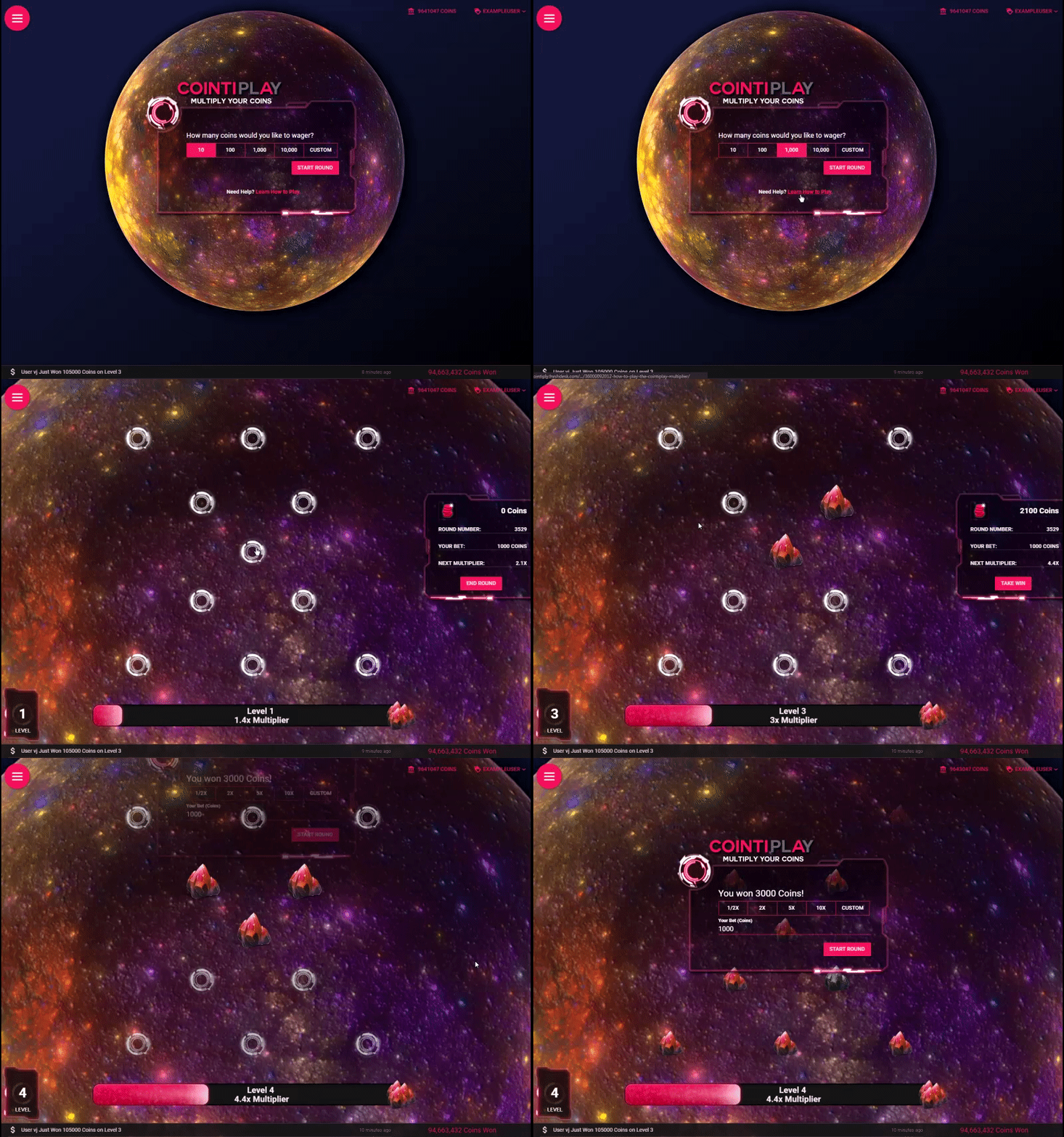
I’m
not a big fan of gambling, so I didn’t mention this in the opening
remarks. You want to earn and hold (or hodl as the bitcoin community
likes to say). That said, if you’re into this for the gambling, you can
wager as few as 10 coins or as many as 50,000 coins in Cointiply’s
multiplier game. The maximum multiplier is 61.3x so you could make as
much as 613 coins from a 10 coin wager, but it’s highly unlikely.
When
you start a new round of the CointiPly Multiplier you will be presented
with 11 different “targets” on the screen. The targets look like small
white circles. If you win, you can either press your luck or play it
safe and click the “Take Win” button at any time to claim your coins and
end the round.
What’s Next
I’ll be researching the impact of referrals and premium memberships on earnings.
If
this has been at all helpful for you, please pass it on to your friends
and family and do let me know if you have any questions.
Get your orders in. We're on our way up to $13,500 by the end November 2020.
The chart below was taken at the end of September. We were in a period of consolidation while the market decided on which way to go, a breakout south or a continuation with the trend that's been established over the last 6 months.
Time to get your buy orders -- we're going higher.
“It's only when the tide goes out that you learn who's been swimming naked.” -Warren Buffett
If you follow any market for an extended period of time you will notice certain patterns in price action. In particular, you will notice that the market moves in waves. It is pushed in certain directions by large buyers and sellers in the markets. These large buyers and sellers have the ability to change the direction of the wave pattern. And, when they all align you get a tsunami. Just like the guy trying to find that monster wave, traders are on the look out for the same phenomena.
At what point do you know the wave is about to "break"? This is the million dollar question, because in surfing and trading, timing is everything.
One of my favorite tools to use in trading are trend-lines. Trend-lines help you to see where the "break" is.
Trend-lines are used to find the trend, but they also tell you when the trend has changed direction. That is, when another large buyer or seller has entered the market and changed the direction of the prevailing trend. If the dominant trend is up and a major player comes in and starts selling, it will push the trend in another direction. This push causes a "break" in the trend. In the world of trading this is referred to as a breakout.
Let's take a moment to familiarize ourselves with the following chart. This is my own chart setup on Ninjatrader 7. We're looking at a price chart of NASDAQ futures (my favorite instrument to trade).
For now, disregard the bottom half of the chart and just focus on the top segment. Also disregard the green, yellow and orange lines -- we'll talk about what those mean later. For now, just focus on the candlesticks and the blue lines. The blue lines are trend-lines.
At first, you will notice blue lines following the trend up and then the trend changes and starts going down.
Now let's get laser focused on the first trend-line going up.
As you can see, the price bounces off the bottom of the trendline three times before finally gaining enough traction to continue upward. It doesn't quite reach the top of the trend-line before it starts trending down. This is when you start looking for a breakout.
The trendline supported the price three times before, and now
it's breaking through the trend line. This breach is the
breakout. Once you see the breakout, it's time to act. As you can see there are two breakouts. The first one is a breakout down and the second is a breakout up.
Both breakouts represent an opportunity to "ride the wave". The trend is up, another wave comes in and starts selling and changes the wave pattern down. The push is so strong that it forces the trend to change direction and that change in direction is marked by a breakout.
In trading, there is no sure thing. The best thing you can do is find an indicator that works 75% of the time. One way to boost your accuracy is by confirming the direction of the breakout with another indicator.
Now we can look at the bottom part of the chart. The breakout down is confirmed with a down movement by both of the bottom indicators. The second breakout is also confirmed by an up movement by both of the bottom indicators.
Now what? Once you find the breakout you want to place a trade with a take profit (TP) that's at least 2x as much as your stop loss (SL). For example, once I see the first breakout I'm going to place a trade with a SL of 40 ticks and a TP at 80 ticks. Some traders like to go for 3x or 4x. That depends on your risk. When you're first starting out, I think it's safe to go for 2x. This way, if you get one trade wrong and one trade right, you're still up.
This is by far my favorite set up. If you have any questions, post them in the comments below or email me at celanbryant @ gmail.com.